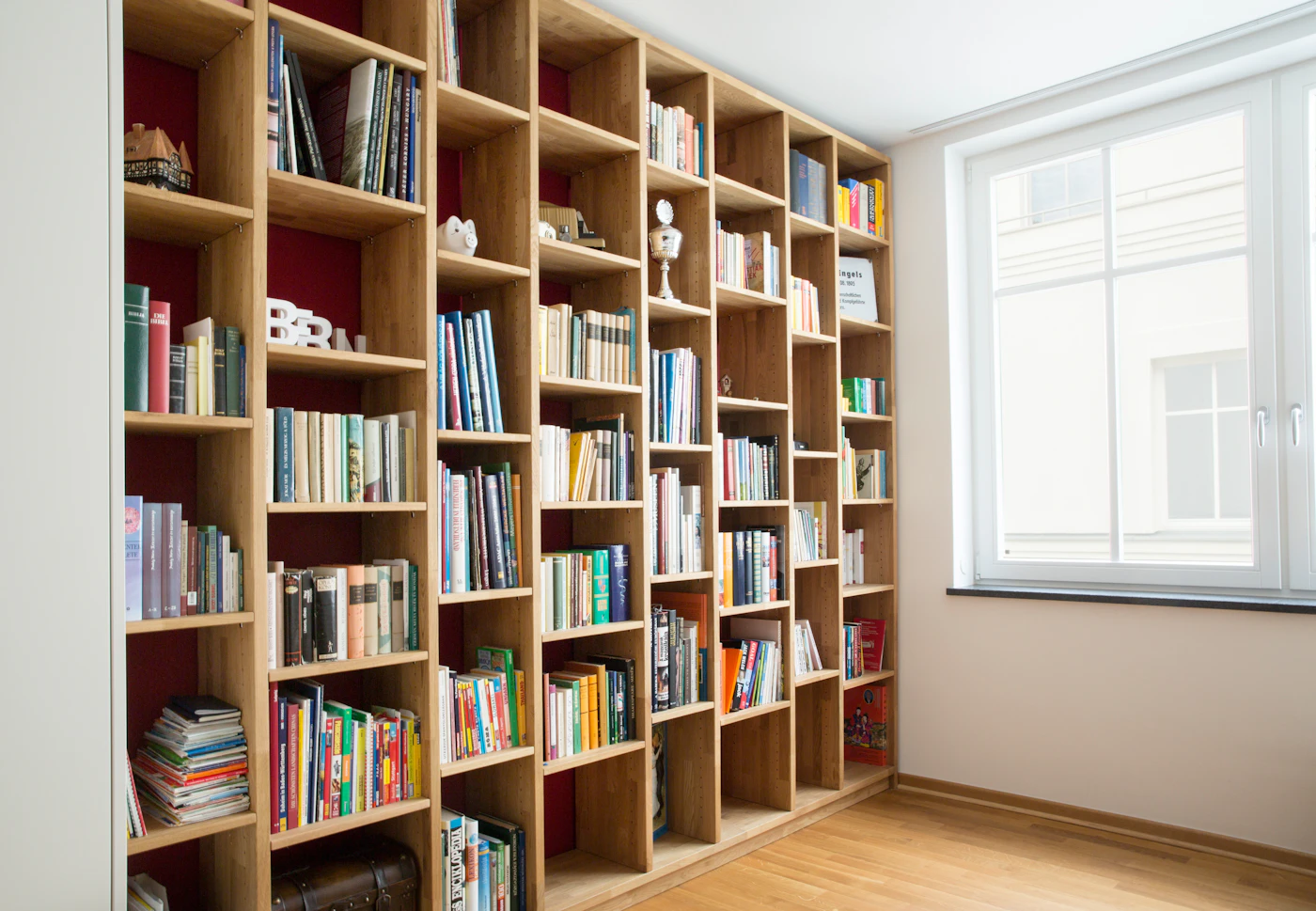
Arrange books, baskets, and meaningful objects without buying an entirely new collection.
In this story
Start with the everyday situationMake the tradeoff deliberatelyBuy containers after sorting the contentsBefore you orderQuestions worth askingWhere to compare optionsShelves tend to become storage first and a display second. That is not a failure, but it helps to decide which job each shelf needs to perform. In a busy living room, the lower shelves may need to hold games while the upper shelves carry books and a few collected objects. A realistic arrangement begins with that division.
Start with the everyday situation
Empty one shelf at a time rather than dismantling the entire room. Group items by use, then remove things that belong elsewhere. Keep a few books vertical for easy retrieval and use a short horizontal stack only where it supports a lightweight object. Avoid hiding books you regularly read behind decorations.
Repeat materials instead of buying matching sets. Two ceramic pieces in similar tones can connect shelves at different heights, while a wooden box adds warmth to a metal frame. Leave gaps between groups. Those gaps make individual objects easier to see and give the whole unit a calmer rhythm.
Make the tradeoff deliberately
Closed baskets are useful for visually noisy necessities, but measure their internal dimensions as well as the outer width. A basket that fits the shelf yet cannot hold the intended board game solves the wrong problem. Soft baskets accommodate odd shapes; rigid boxes are easier to stack and label.
Treat plants as living objects with requirements, not filler for an empty corner. Match their placement to the light available and use a saucer or sealed planter to protect the shelf. Artificial greenery can suit an inaccessible location, but a single honest sculptural object is often simpler to clean.
Buy containers after sorting the contents
Measure the usable shelf depth from the front edge to any backing or cable opening. A basket can appear suitable from its width while projecting awkwardly at the front. Leave enough room to grasp handles and remove it without shifting adjacent books.
Choose bookends according to the weight they need to hold. Lightweight decorative shapes may be enough for a few paperbacks but struggle with heavy books. Check that any base sits flat and will not scratch the shelf when the arrangement changes.
An object deserves a place if you enjoy seeing it or need to reach it. Avoid purchasing multiple filler pieces simply because a shelf has open space. Use a meaningful photograph, a practical box, or a ceramic piece with enough visual weight to stand alone.
A light inside shelving can highlight a display, but plan the cable route before buying. Avoid placing a fixture where stored items can press against it. Follow the product’s clearance and installation guidance, especially when a unit has enclosed compartments or combustible materials nearby.
Before you order
- Measure the available space and the route from the entrance.
- Check the full product dimensions, including handles or projecting parts.
- Match the care instructions to the time and equipment you have.
- Read delivery, return, and assembly conditions for the actual item.
- Decide where the replaced item will go before bringing something new home.
Questions worth asking
How much empty space should a shelf have?
There is no required percentage. Leave enough separation that groups are visible and objects can be removed without dismantling the display. A shelf holding frequently used books needs a different arrangement from one devoted to ceramics.
What deserves the biggest share of the budget?
Prioritize the piece you touch or use most often and any work needed to install it correctly. Decorative extras can wait. If the main problem is layout, test a rearrangement before buying: a different position can sometimes provide the improvement you expected from a new object.
How do you avoid a rushed purchase?
Save the measurements, compare two or three plausible options, and leave the decision overnight when possible. A sale should not override the original requirement. If none of the options fits the room and the routine, keep looking rather than accepting a compromise that creates another problem.
Where to compare options
Use the IKEA storage and organization as one starting point for comparing current options. Check each item’s measurements, care guidance, delivery, and return terms before buying. This is an ordinary, untracked retailer link, rather than an affiliate recommendation or evidence of hands-on testing.
Our guides explain how to choose, rather than claim hands-on tests. Check current product details, returns and travel conditions directly before booking or buying. Our editorial approach.